Effect of Customer Order Lead Time on Safety Stocks
What's the effect of customer order lead time in inventory management and safety stock calculations?
- By
- July 3rd, 2018
What's the effect of customer order lead time in inventory management and safety stock calculations?
A look at how you can use product and customer ABC segmentation for Inventory management.
In an ideal world, your products would have on-shelf availability whenever your customer needs them. However, this is often not the case for many businesses. It’s also essential to note that, not all stock outs or out-of-stock(OOS) carry the same severity levels or require the same form of actions. In this blog post, we’ll discuss a simple coding system using descriptive analytics that can help you easily identify different severity levels for your stock out.
I discussed some of the possible pitfalls when using inventory turnover as a measurement for effective inventory management. In this post, I’ll describe a simple technique for measuring inventory effectiveness.
Use this simple tool for identifying areas of potential improvement in the business to create an effective inventory management process. This type of measurement allows for a more widespread understanding of the nature of inventory and fosters action to prevent a build-up of non-value-adding "drag".
Join us as we discuss how to use inventory or supply planning to properly calculate and project future inventory taking into consideration capacity constraints.
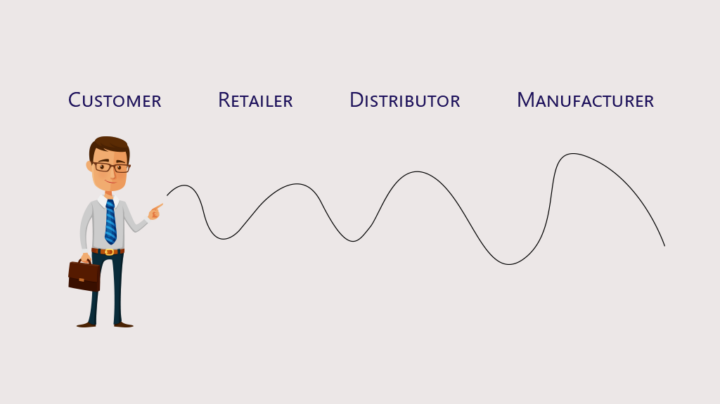
The bullwhip effect is a concept for explaining inventory fluctuations or inefficient asset allocation as a result of demand changes as you move further up the supply chain. As such, upstream manufacturers often experience a decrease in forecast accuracy as the buffer increases between the customer and the manufacturer.
I mean who suffers directly when finished product inventory runs amuck by level, mix, or availability? Well, we all do, don’t we? After all, if we made it and can’t sell it, what have we done? Or, what if we promised it to customers but haven’t made it? Until we give finished goods velocity, no profits roll into the business meaning, no revenue (assuming when it sells, it gains velocity). Just think of the other side of the coin when it goes to the scrap heap for a write off (terminal velocity).
When you talk to any manufacturer no matter how large or small about their concerns, improved inventory management is bound to be a part of the conversation. To celebrate manufacturing day today, we thought it would be beneficial to take a closer look at how inventory strategy keeps evolving using an infographic from Arkieva based on research conducted by Aberdeen.
How can businesses improve working capital management? In this week’s ‘Supply Chain Talk’, Arkieva CEO Harpal Singh discusses how to identify inventory buffer factors to help control working capital fluctuations.
Wondering how inventory is modeled in supply chain planning systems? Here's what you need to know.
When it comes to inventory optimization, companies often have to play a delicate balancing game to ensure that they have...
Please tell us a little bit about yourself to help us better assist you.