

What Is Multi-Echelon Inventory Optimization (MEIO)?
Multi-echelon inventory optimization (MEIO) is an inventory planning approach that sets stock levels for every location in a supply network at the same time. Instead of planning each plant, warehouse, or distribution center in isolation, MEIO accounts for how inventory at one level protects the levels below it, then positions stock at the points where it delivers the target service level at the lowest total cost.
MEIO at a Glance
| What it optimizes | Where to hold inventory (placement) and how much to hold at each node (stock levels), across all echelons simultaneously |
| vs. single-echelon | Single-echelon planning optimizes each level on its own; MEIO optimizes the network as one system |
| Five pillars | Well-defined supplier network, precise demand forecasting, optimized inventory levels, simplified order processes, data and analytics |
| Four network types | Serial, assembly, distribution, general |
| Primary benefits | Less working capital tied up in inventory, higher service levels, faster response to supply and demand volatility |
| Academic origin | Clark and Scarf, “Optimal Policies for a Multi-Echelon Inventory Problem,” Management Science (1960) |
MEIO vs. Single-location and Single-echelon Inventory Optimization
Single-location optimization plans each site independently, single-echelon optimization plans each level of the network independently, and MEIO plans all levels together. The difference is whether the model can see that stock held upstream reduces the stock needed downstream.
An echelon is one level, or tier, of a supply network: raw material suppliers, plants, central distribution centers, regional warehouses, and customer-facing locations are each an echelon. The three approaches build on each other:
- Single-location inventory optimization. Each site sets its own reorder points and safety stock using its own demand and lead time. This works for simple networks with one or two stocking points, but it ignores every other site.
- Single-echelon inventory optimization. All sites on the same level (for example, every regional warehouse) are optimized together, but each level is still treated in isolation. Because the model cannot see cross-level effects, every tier buffers against the same uncertainty. The result is duplicated safety stock, amplified order swings as variability passes upstream (the bullwhip effect), and stock fluctuations between levels.
- Multi-echelon inventory optimization. MEIO combines stock-level optimization with placement decisions across the full network, from raw materials to finished goods. It treats upstream inventory as a buffer that shortens effective lead times for downstream sites, so it can decide deliberately which echelon absorbs uncertainty and which echelons can run lean.
| Single-location | Single-echelon | Multi-echelon (MEIO) | |
|---|---|---|---|
| Scope of each decision | One site | One level of the network | Every level of the network |
| Sees cross-level effects | No | No | Yes |
| Safety stock | Set per site | Set per level; often duplicated across levels | Placed where it protects the most demand at the lowest cost |
| Best fit | One or two stocking points | Networks with a single dominant tier | Networks with two or more stocking tiers |
Key Pillars of Multi-echelon Inventory Optimization
Multi-echelon inventory optimization rests on five pillars: a well-defined supplier network, precise demand forecasting, optimized inventory levels, simplified order processes, and a strong data and analytics foundation. A gap in any one of them limits how much the optimization can deliver.
1. A well-defined supplier network
MEIO requires an accurate model of the network before it can optimize it. That model includes the number and location of facilities at each stage, the lead times, transport modes, and costs between them, and a complete picture of how material flows from suppliers to customers. Missing lanes or outdated lead times produce targets that look optimal on paper and fail in practice.
2. Precise demand forecasting
Every echelon needs a demand signal it can trust. MEIO uses forecasts at each stage, along with the forecast error around them, so each level orders confidently and on time. Forecast error matters as much as the forecast itself, because it drives how much buffer each node needs. Strong demand forecasting upstream of the optimization is a prerequisite, not an add-on.
3. Optimized inventory levels
MEIO calculates the optimal stock for each node rather than applying one policy everywhere. Keeping those levels on target requires software that monitors inventory positions, tracks stock by location, and records consumption history so targets can be recalculated as conditions change.
4. Simplified order processes
Clear, consistent ordering rules make MEIO targets executable. Each product needs a defined economic order quantity (EOQ), safety stock, reorder point, and lead time. When a portfolio has too many items for item-level control, ABC classification groups SKUs by value or volume so planners apply the tightest control where it matters most.
5. Focus on data and analytics
MEIO improves as its data improves. Demand history, lead time variability, supplier on-time performance, and multi-location inventory visibility all feed the model. Supplier reliability signals are especially valuable: a supplier whose lead times vary widely needs a larger buffer behind it than one who delivers consistently. Inventory analytics turn this data into the inputs MEIO needs.
What Are the Benefits of MEIO?
MEIO delivers five main benefits: lower inventory cost, higher customer service, better handling of volatility, better management of lead times, and higher return on inventory investment. Each one comes from replacing level-by-level buffering with a single network-wide plan.
1. Enhanced cost-efficiency
Without MEIO, every level holds its own safety stock against the same demand uncertainty, and capital gets trapped in slow-moving surplus. With MEIO, buffers are consolidated where they protect the most demand, which lowers total inventory at the same service level.
The effect is measurable. The table below compares holding safety stock at three regional warehouses against pooling it at one central distribution center, using the standard safety stock formula (z × σ × √lead time). Each warehouse sees independent weekly demand with a standard deviation of 100 units, lead time is four weeks, and the service target is about 95% (z = 1.65).
| Where safety stock is held | Demand variability covered | Safety stock |
|---|---|---|
| 3 regional warehouses, planned separately | 100 units per week at each site | 330 units × 3 = 990 units |
| 1 central distribution center (pooled) | 100 × √3 = 173 units per week combined | 1.65 × 173 × 2 = 572 units |
| Difference | 418 units, or 42% less |
Pooling works because independent demand swings partly cancel out when they are combined. This is the “square root law” of inventory centralization, described by David Maister in the International Journal of Physical Distribution (1976). MEIO applies the same logic across every echelon, and it weighs the savings against the longer lead time to the customer that central stocking creates.
2. Elevated customer service
Without MEIO, stock sits where history put it, not where demand is, so some locations run short while others hold excess. With MEIO, the right stock sits at the right node, which reduces shortages at the downstream locations that serve customers directly.
3. Improved management of supply or market volatility
Without MEIO, a disruption at one tier forces each level to react on its own, often by over-ordering. With MEIO, planners can see where buffers sit across the whole network and respond at the point that resolves the problem fastest, whether that is a plant, a central distribution center, or a regional warehouse.
4. Better management of lead times
Without MEIO, misestimated or fluctuating supplier lead times ripple through every echelon as late orders and emergency expedites. With MEIO, lead time variability is an explicit model input, so buffers are sized and placed to absorb it before it reaches customers.
5. Improved return on investment
Without MEIO, inventory investment is spread by habit and rules of thumb. With MEIO, inventory dollars go to the locations and items that earn the most service per dollar, which improves margin and return on the capital tied up in stock.
Common Challenges When Implementing MEIO
The three most common challenges in implementing MEIO are data management, supplier coordination, and legacy system integration. All three are solvable, and addressing them before go-live is what separates a working MEIO program from a stalled one.
Data management
MEIO needs inventory, demand, and lead time data from every tier, but tiers often run separate inventory policies and separate systems. Teams must also balance data security against data sharing, especially when some echelons belong to partners. A single, governed source of network data is the foundation.
Supplier coordination
MEIO works best when suppliers share lead times, capacity, and performance data. Getting buy-in across many suppliers takes deliberate relationship management and coordination technology, such as shared portals or supply planning workflows that make commitments visible to both sides.
Legacy system integration
Many organizations run a separate system for each echelon, and those systems were not built to share data. MEIO requires integration between these siloed systems and modern planning tools. Planning for that integration early, including data mappings and refresh frequency, prevents MEIO from running on stale inputs.
Types of MEIO Networks
MEIO models four network types: serial, assembly, distribution, and general. The type determines how inventory flows between echelons and where buffers are most effective.
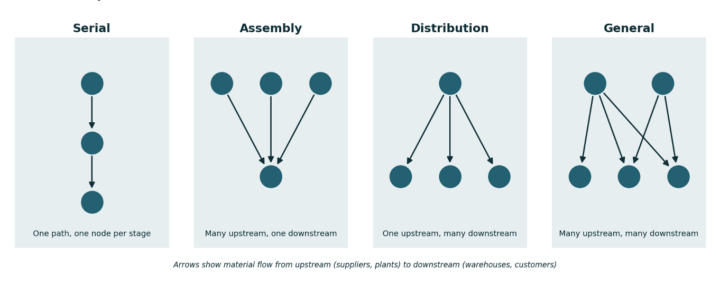
Four multi-echelon inventory optimization network types: serial, assembly, distribution, and general
- Serial network. Material follows a single path up and down the chain, with one node at each stage. Example: one supplier feeds one plant, which feeds one warehouse.
- Assembly network. Multiple upstream nodes feed a single downstream node. Example: several ingredient or component suppliers feed one production plant.
- Distribution network. A single upstream node feeds multiple downstream nodes. Example: one central warehouse supplies several regional distribution centers. This is the most common case for finished goods.
- General network. Multiple upstream nodes feed multiple downstream nodes, and flows can cross. Example: several plants supply several distribution centers, each of which can source from more than one plant. Most real process manufacturing and CPG networks are general networks.
MEIO Best Practices
The most effective MEIO programs start with clean network data, measure forecast error at every echelon, and recalculate targets on a regular cadence rather than treating them as fixed. Five practices make the difference:
- Model the network you actually run. Map every stocking location, lane, and lead time, including the lanes that only activate during shortages.
- Measure variability, not just averages. Safety stock is driven by forecast error and lead time variability. Track both at every node.
- Decide where to decouple. Choose deliberately which echelons hold strategic buffers and which run lean. Graves and Willems formalized this placement problem in Manufacturing & Service Operations Management (2000).
- Segment before you optimize. Use ABC or similar classification so high-value and high-volume items get item-level attention and the long tail gets policy-level control.
- Recalculate on a cadence. Refresh targets as demand, lead times, and costs change, and connect them to your S&OP process so inventory decisions reflect the business plan.
Arkieva Inventory Planning calculates optimal inventory and safety stock levels across multi-echelon networks, using measured forecast error and lead time variability instead of rules of thumb. Arkieva is recognized by Gartner® in the Supply Chain Planning Solutions Magic Quadrant™.
Frequently Asked Questions
Is implementing MEIO expensive?
The cost of MEIO depends on network complexity, data readiness, and how much integration is needed with existing systems. Most of the return comes from lower working capital and fewer stockouts, so companies with multi-tier networks and high inventory value typically see the fastest payback.
Can MEIO be integrated with other supply chain strategies like JIT or safety stock?
Yes. MEIO sets safety stock at each echelon rather than replacing it, and it complements just-in-time (JIT) by deciding where strategic buffers should sit so that other nodes can run lean.
What are the risks of multi-echelon inventory optimization?
The main risks of multi-echelon inventory optimization are poor data quality, inaccurate lead time or demand assumptions, and weak adoption by planners. Over-centralizing inventory is another risk: it lowers total stock but lengthens lead time to customers, so MEIO targets should be checked against service requirements.
How does MEIO handle sudden changes in demand?
MEIO responds to demand changes by recalculating stock targets as forecasts and forecast error update. Because it sees buffers across the whole network, it can rebalance inventory between echelons instead of relying on each location to react on its own.
Put Your Inventory Where It Works Hardest
Multi-echelon inventory optimization replaces tier-by-tier guesswork with one plan for the whole network: less stock in total, placed where it protects the most service. The first step is seeing your network as a single system.
Ask for a one-on-one demo of the Arkieva supply chain planning solution → [Request a Demo]

- By Arkieva Software
- October 19th, 2026
- Inventory Optimization, Safety Stock



FEATURED RESOURCES

RECENT POSTS




Contact us
Please tell us a little bit about yourself to help us better assist you.