You've Invested in Resilience. You're Still Getting Surprised.
In chemicals, food and beverage, and complex process manufacturing, organizations have invested heavily in resilience. They’re still being caught off guard by disruptions that were predictable in hindsight. The problem isn’t awareness. It’s that their planning systems were built for a stable world.

Visibility Tools
Scenario Planning

Safety Stock
You’re Still Getting Caught Off Guard by Your Planning System.
This pattern shows up the same way across chemicals, specialty chemicals, process manufacturing, food and beverage, and advanced materials:
- Plans produced on Monday are being repaired by Wednesday because the assumptions they were built on didn’t hold
- Scenario planning tools exist, but they sit outside the baseline plan. They help you imagine alternatives, not change what’s executed
- Safety stock and manual buffers do the actual risk management work: blunt, expensive, and invisible to finance leadership
- When boards ask about resilience, supply chain leaders often can’t give a measurable answer, because resilience has never been quantified or designed into their plan
- The planning function spends most of its energy repairing plans rather than informing decisions, making it structurally impossible to operate strategically
In chemicals, a yield deviation or supplier concentration risk can cascade across campaign sequences that can’t easily be reordered. In food and beverage, shelf-life constraints, ingredient variability, and allergen changeovers lead to expensive consequences for a single wrong assumption.
Most planning platforms optimize for cost in a world that no longer behaves predictably. They produce plans that are correct until they’re not. And leave teams to spend their week repairing rather than deciding.

Visibility Tools and Scenario Planning Don't Change the Baseline Plan.
The resilience investments most organizations make are real. They’re also responding to the wrong part of the problem:

Visibility Tools
Show you what happened after it happened. They don’t change what the plan assumed.
Scenario Planning
Help you imagine alternatives, disconnected from the baseline plan and from real probabilities.

Safety Stock
Absorb shocks after they arrive: expensively, and invisibly to your board.
None of these tools change the baseline plan. So when disruption arrives, the plan is still the problem.
Experienced planners carry tacit knowledge that never makes it into the system: the allergen sequencing logic in one scheduler’s head, the yield adjustment experience has taught them to build in, the supplier who always runs late, the seasonal pattern that never makes it into the forecast. When that planner leaves the room, the plan loses the judgment they brought to it.
Plans get built on deterministic assumptions like single-number forecasts, assumed lead times, fixed capacities, and get repaired when reality diverges. That divergence is predictable, but most planning systems treat it as a surprise.

Resilience Isn’t a Response Capability. It’s a Planning Architecture.
The question that matters isn’t how fast you can replan when something breaks. It’s whether your plan was built to absorb disruption before it breaks.
Organizations that treat risk as something to detect and react to will keep repairing plans. Organizations that design risk into the plan – embedded in the planning math before the optimizer runs – will stop being surprised by what’s predictable.
-
What is Shift-Left Planning?
Shift-Left Planning takes its logic from software development, where security testing used to happen at the end of the build cycle, when it’s too late to fix. The industry learned to embed it earlier, before commitments are made.
Applying this principle to supply chain planning means embedding risk inputs directly into the planning engine before the optimizer runs. Not as a post-plan overlay or offline scenario, but inside the planning math from the start:
- Probabilistic demand rather than single-number forecasts – including seasonal variability and ingredient supply risk
- Supplier reliability scores rather than assumed lead times – including concentration risk and regulatory exposure
- Yield and throughput variability rather than fixed capacities – including batch yield deviation and shelf-life constraints
- Allocation and resilience trade-offs rather than purely cost-optimized plans
What your best planner knows intuitively should be in every plan by design.
How Arkieva Puts Shift-Left Planning Into Practice.
Arkieva is built for complex manufacturing environments where planning must reflect real constraints like batch processes, shelf-life windows, campaign sequencing, yield variability, and multi-site coordination – not abstract them away. Shift-Left Planning is both a methodology and a way of working in our software: it turns the tacit risk judgment experienced planners carry into explicit, quantified inputs embedded in every plan.
In practice, that means:
- Risk is detected and quantified before the optimizer runs, not discovered mid-execution when a campaign sequence is already committed
- Uncertainty is made explicit – probabilistic demand, supplier fragility scoring, yield and shelf-life variability – rather than hidden behind safety stock
- The baseline plan is risk-adjusted before it’s published, not patched afterward when the ingredient shortage or yield deviation surfaces
- Resilience becomes measurable: plan stability, shock absorption capacity, working capital at risk – metrics that belong in a board conversation
This is where AI comes in. It’s the mechanism that makes risk-aware planning possible at scale: anomaly detection, probabilistic forecasting, supplier fragility scoring. It applies the inputs that make Shift-Left Planning work consistently across every plan.

Choosing a planning posture – not just a plan
When risk is in the planning math, supply chain leaders can make an explicit, board-legible choice about resilience rather than inherit a default posture. Resilience isn’t a condition you should hope for. It’s a posture you can measure, and Arkieva makes it visible.

Aggressive
Prioritize cost and service efficiency. Accept higher exposure to disruption. Know what you’re trading.

Balanced
Optimize across cost, service, and resilience. Quantify and consciously accept residual risk.

Conservative
Prioritize absorption capacity. Accept cost premiums in exchange for lower disruption exposure.
Shift-Left Planning:
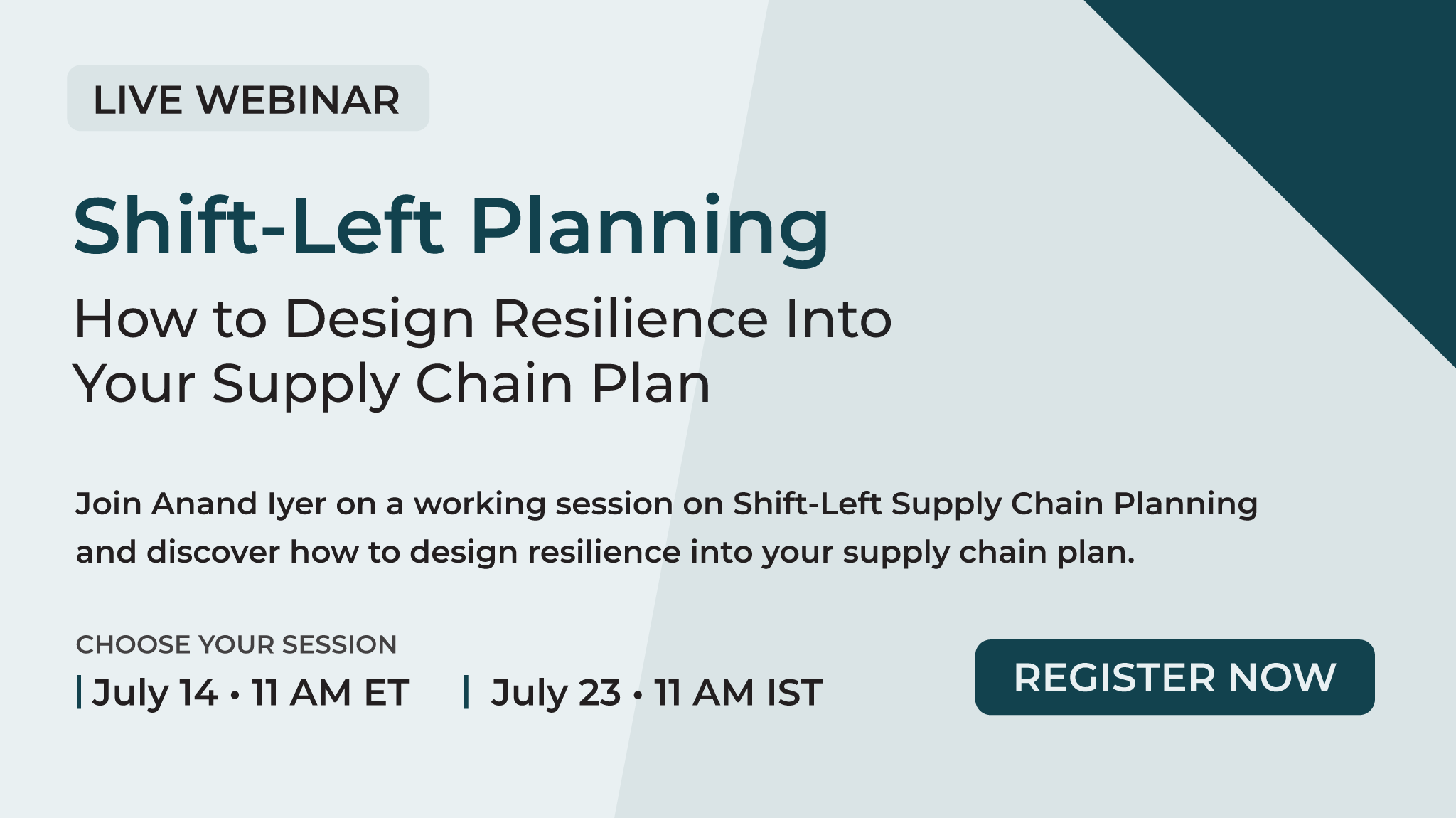
How to Design Disruption Into Your Supply Chain Plan
Hosted by: Anand Iyer | 45-Minute Session
Most organizations know risk should inform their plans. Most planning systems aren’t built to do that consistently. This session will introduce Shift-Left Planning as a concept that reorients how supply chain executives think about the relationship between planning and resilience, and helps them close the gap.
Gartner® Names Arkieva a Challenger in 2026 Magic Quadrant™ for Supply Chain Planning Solutions
Recognized for the 11th consecutive year for delivering powerful, flexible planning tools that drive measurable results.


The Plan That Gets Repaired Every Week Isn’t Really a Plan.
Disruption doesn’t arrive unannounced. The organizations that stop being surprised by the predictable are the ones that built risk into the plan, so their system can absorb it.