

What is Sales and Operations Planning (S&OP)?
Every process manufacturer runs some version of a monthly planning meeting where sales, finance, and operations try to agree on what’s coming next. Sales and operations planning (S&OP) is the formal name for that meeting, and it’s the backbone of how most manufacturers align demand, supply, and financial targets into one plan. This guide covers what the S&OP cycle involves, where it breaks down, and what a modern platform adds to the process.
Sales and operations planning (S&OP) is a regularly scheduled process in which finance, sales, and marketing collaborate with demand, supply, inventory, and capacity planners. Together, they project demand and the resources needed to meet it, and produce a cohesive production plan. S&OP has been a procedural staple of supply chain planning for more than three decades.
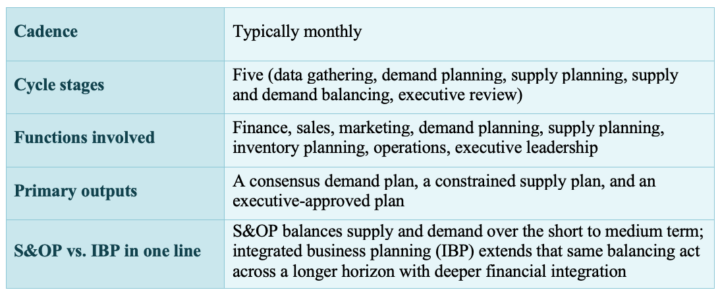
At a Glance
What is the Difference Between S&OP and Integrated Business Planning (IBP)?
S&OP is one component of IBP. IBP takes the cross-functional balancing act that S&OP performs and extends it, typically 18 to 24 months. IBP tightly integrates financial planning, new product introduction, and long-range strategy.
Most companies build S&OP first because it delivers value on a shorter timeline. It aligns demand, supply, and inventory month-to-month. IBP becomes the natural next step once that monthly discipline is in place, expanding the same process into a longer-range capability that connects operational plans to financial targets. Companies with mature S&OP can graduate to IBP within a few years of establishing the monthly cycle, once the underlying data and cross-functional habits are already working.
What is the Traditional S&OP Cycle?
The traditional S&OP cycle runs through five stages, either one after another on a monthly calendar or, in more mature planning environments, concurrently.
- Data gathering: Planners pull sales history, market intelligence, promotional calendars, and current inventory and capacity positions into a shared data set that every function will work from.
- Demand planning: Sales, marketing, and demand planners reconcile a statistical forecast with market knowledge to produce one consensus demand plan.
- Supply planning: Supply and production planners test that demand plan against material availability, capacity, and lead times to determine what can be produced.
- Supply and demand balancing: Where demand exceeds what supply can deliver, or supply exceeds what’s needed, planners work through the trade-offs. Either allocate scarce capacity, adjust inventory targets, or flag a gap for leadership.
- Executive review: Leadership reviews the balanced plan against financial targets and approves it, or sends specific gaps back for further work.
In a traditional calendar, these stages run in sequence over roughly three to four weeks, closing just in time to start again. In more concurrent environments, later stages start before earlier ones fully close, which shortens the cycle without skipping anything.
What are the Benefits of S&OP for the Supply Chain?
A working S&OP process improves forecast accuracy by getting sales, marketing, and operations to agree on one number, instead of working from three different spreadsheets. That single number carries through to several measurable benefits: lower inventory carrying costs, because supply is planned against a forecast the business stands behind; freed working capital, as safety stock and excess inventory come down; better on-time delivery, because supply planning starts from a demand signal the plant can trust; and higher customer satisfaction, since service levels stop swinging with each surprise.
S&OP also gives sales, production, and procurement a shared view of what’s coming, which shortens the distance between a market opportunity and a resourced plan to meet it. Teams that already run S&OP well are positioned to respond to a new opportunity in days rather than the weeks it takes to build cross-functional consensus from scratch each time.
Why Does the Traditional S&OP Process Need Improvement?
The traditional monthly S&OP cycle was built for a slower pace of change than most process manufacturers face today, and five failure modes show up repeatedly.
- The cycle is too linear and too rigid. A plan approved on the 25th of the month can be overtaken by a supplier delay or a demand shift by the 27th, with no scheduled point to revisit it before the next cycle.
- Functional silos plan for the process, but not with each other. Sales optimizes for revenue, operations for efficiency, and finance for margin, often against different assumptions about the same demand signal.
- KPIs across departments aren’t aligned to the same outcome. A decision that looks right in one function’s metrics can work against another’s.
- Data pulled from disconnected ERP systems and standalone spreadsheets is often stale by the time it reaches the executive review. This undermines the plan before leadership signs off on it.
- Feedback loops between cycles are limited. Even if a planner can anticipate a shift mid-month, there is no formal channel to plan for it before the next monthly meeting.
What are the Three Elements of Effective Sales and Operations Planning?
What-if Scenario Simulations
Effective S&OP requires the ability to model trade-offs across conflicting KPIs before committing to a plan. A planner needs to be able to ask, and answer, questions like: What happens to service levels if a new product launch sells slower than forecast? What happens to margin if a promotion pulls forward more demand than the plan accounted for? What happens to the network if a key supplier’s plant goes down for two weeks?
Answering those questions well requires a shared data model across demand, supply, and finance. It also requires the ability to build and compare multiple scenarios in minutes rather than days, and a way to quantify the cost, service, and risk trade-offs of each option side by side. Done this way, risk is quantified as the plan is built, rather than discovered once the plan is already in motion.
Cross-functional Planning
S&OP only works if it breaks down the functional silos it was designed to replace, with every function planning against the same shared metrics rather than its own local targets. That requires clear ownership across roles: an S&OP process owner who runs the cycle, finance, a demand planner, sales and marketing, a supply planner, an inventory planner, operations, and an executive sponsor who signs off on the final plan. Each role brings a different constraint and a different stake in the outcome. The process exists to reconcile all of them into one plan the business can execute against.
S&OP Record-Keeping
Every S&OP cycle produces context that’s easy to lose: which trade-offs were debated, why a particular option was chosen over another, and what assumptions the plan was built on.
Capturing that context in a single system of record, rather than in meeting notes and email threads, lets planners retrieve past scenarios that resemble current conditions instead of starting the analysis over from a blank page each time a similar situation comes up.
How Can Continuous, Concurrent Planning Improve the S&OP Cycle?
Concurrent planning synchronizes plans across time horizons, functions, and organizational boundaries. This extends that same synchronization out to suppliers and customers rather than stopping at the company’s four walls. Concurrent planning bridges short-term, high-frequency, lower-impact decisions, such as a schedule adjustment this week, with long-term, low-frequency, higher-impact decisions, such as a capacity investment eighteen months out. Both draw on the same current data rather than two plans that drift apart between monthly resets.
From Sequential to Concurrent: The S&OP Cycle
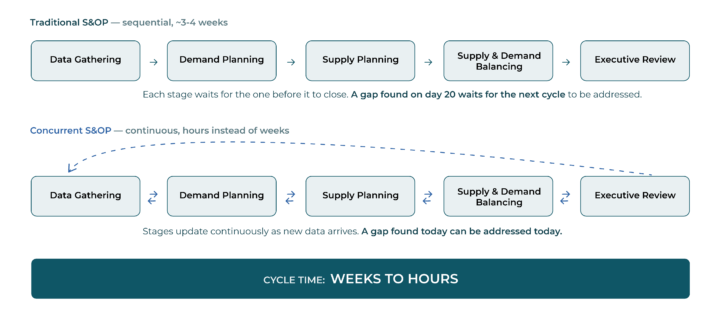
The practical effect of concurrent planning is speed without giving up preparation: plans that once took weeks to update in response to new information can update in hours, because the underlying data and the cross-functional agreements don’t need to be rebuilt every time.
What are the Benefits of S&OP Software?
Purpose-built S&OP software changes what the process can do, not just how fast it runs.
- Synchronized demand, supply, inventory, and finance planning in one platform, replacing separate spreadsheets that have to be manually reconciled.
- Rapid comparison of multiple planning scenarios side by side, rather than building one scenario at a time.
- Consolidated data pulled directly from ERP and planning systems, reducing the manual data-wrangling that eats up the first days of every cycle.
- Continuous synchronization of plans as conditions change, rather than waiting for the next scheduled cycle to catch up.
- Financial metrics built directly into the planning process. A plan’s cost and margin impact is visible before it’s approved.
- Rolling forecasts that update continuously instead of resetting from scratch every month.
- Scalability across more SKUs, sites, and scenarios than manual methods can realistically handle.
- Risk exposure quantified earlier in the process, because gaps between demand and supply show up as the plan is built rather than at execution.
Who Benefits Most From S&OP Software?
- Executives get end-to-end visibility into the plan as it develops, rather than waiting for a full monthly cycle to close before seeing where things stand.
- Finance gets goals aligned with operations and earlier visibility into cost and revenue risk, instead of learning about a gap after the plan has already been executed against.
- Managers get cross-department collaboration built on shared data, rather than reconciling competing spreadsheets in every planning meeting.
- Planners get direct access to the data behind the plan and more confidence in day-to-day decisions, because the analysis that supports a call is already there. The software extends a planner’s judgment, and the final call stays with the planner.
Frequently Asked Questions
How Often Should the S&OP Process Run?
Monthly is the traditional cadence, and it remains the default for most process manufacturers because it matches typical procurement and production lead times. Companies with software that supports concurrent planning often layer a continuous, always-current view on top of the monthly cycle, so the formal monthly review still happens, but plans stay current in between.
Who Should Own the S&OP Process?
A dedicated S&OP process owner should run the cycle, with clear participation from finance, sales, demand planning, supply planning, and operations, and with an executive sponsor accountable for the final approved plan. Ownership without cross-functional participation tends to produce a plan that one function follows, and the others work around.
What KPIs Should S&OP Track?
Forecast accuracy, inventory turns, on-time delivery or service level, and plan adherence are the core KPIs most S&OP processes track. Each one measures a different point where the plan can succeed or break down. Some organizations add working capital and margin impact once finance is fully integrated into the cycle.
What is the Difference Between S&OP and Demand Planning?
Demand planning is one input into S&OP. It forecasts what customers are likely to want, and S&OP takes that forecast and balances it against supply, capacity, and financial constraints to produce one plan the whole business can execute.
A monthly meeting can align a forecast. A platform built for process manufacturing can keep that plan current between meetings, with the constraints your plants run on already built in. Talk to the team at Arkieva.

- By Arkieva Software
- September 9th, 2026
- S&OP









FEATURED RESOURCES

RECENT POSTS




Contact us
Please tell us a little bit about yourself to help us better assist you.